
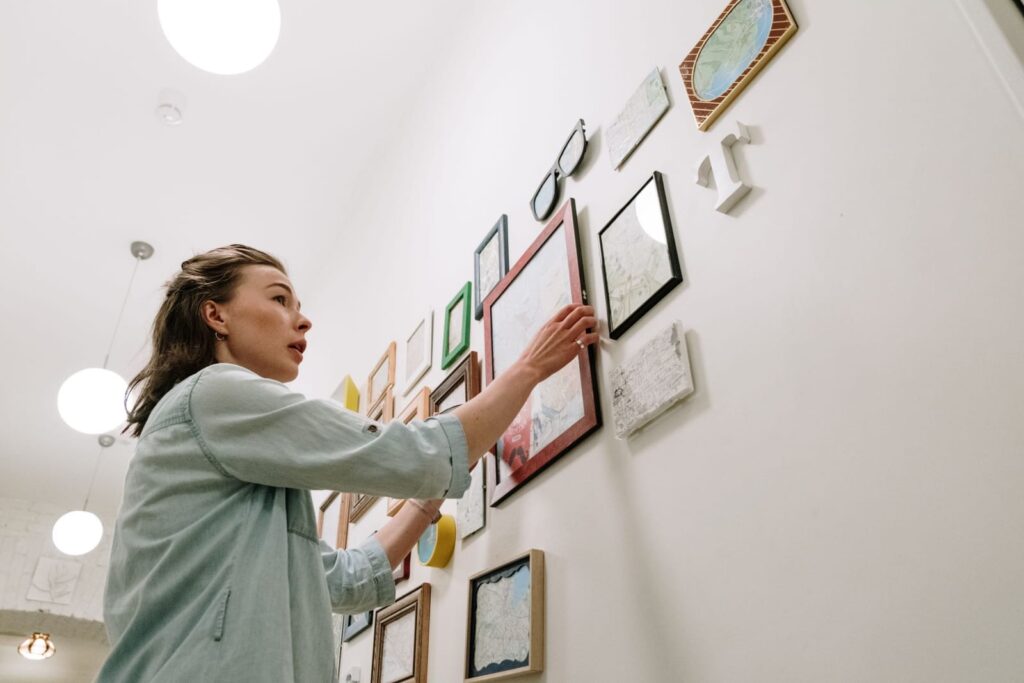
A gallery wall looks effortless when it is done well and chaotic when it is not, and the difference is almost never the art. It is the spacing, the height and the amount of planning that happened before the first nail went in. The good news is that the method galleries use to hang a group of works translates directly to a hallway or a living room, and it needs nothing more exotic than paper, tape, a level and a pencil.
Decide on the arrangement first
There are two basic approaches, and it helps to choose one deliberately.
A grid uses frames of the same size, or at least the same outer dimensions, arranged in rows and columns with identical gaps. It is calm, architectural and forgiving of very different images, because the structure holds everything together. It is also unforgiving of mistakes: a single frame a centimetre out of line is obvious.
A salon hang mixes sizes, orientations and frame styles in a looser cluster. The name comes from the crowded, floor-to-ceiling displays of the Paris Salon exhibitions, and the domestic version is more restrained but keeps the spirit. It suits collections that have grown over time, and it can absorb new pieces later. Its risk is that without some underlying order it reads as clutter.
Between the two sits the most useful compromise: a mixed group held together by a shared edge or a shared centre line. All the frames might align along an invisible horizontal line through the middle, or along a common top edge, with varied sizes above and below. The eye picks up the line and reads the group as intentional.
Find something that ties the group together
A group needs at least one thing in common. It might be the frames, all black or all natural oak. It might be a colour that recurs across the works, or a subject, or a medium, such as a wall of works on paper. If the frames vary, keep the mats consistent. If the art varies wildly, keep the frames consistent. Trying to vary everything at once is how gallery walls become visual noise.
Choose an anchor piece, usually the largest or strongest work, and build around it. It generally goes near the centre of the arrangement, slightly off-centre if you want a less formal feel, and the rest of the works balance its weight.
Plan it on the floor, then on paper
Lay the frames out on the floor in front of the wall and move them around until the arrangement works. Photograph the options from above so you can compare them. Measure the overall width and height of the arrangement you like.
Then make a paper template for each frame: trace it onto brown paper or newspaper and cut it out. On each template, mark the exact point where the hanging hardware will sit. For a picture wire, pull the wire taut upwards as it will be when hung and measure from that point to the top of the frame. For D-rings or sawtooth hangers, measure their positions directly. Tape the templates to the wall with low-tack tape and live with them for a day. It is far easier to move paper than to fill holes.
Getting the height right
Most people hang art too high. A widely used convention in galleries and museums is to place the centre of a work, or the centre of a whole group, at around 57 to 60 inches from the floor, roughly 145 to 152 centimetres. That is approximately average eye level, and it is why art in a well-hung exhibition feels comfortable to look at.
For a gallery wall, treat the entire arrangement as a single picture and put its centre on that line. Then adjust for the room:
- Above furniture, such as a sofa, sideboard or bed, the relationship with the furniture matters more than the eye-level rule. A common rule of thumb is to leave a gap of roughly 6 to 10 inches, about 15 to 25 centimetres, between the top of the furniture and the bottom of the lowest frame, so the art and the furniture read as one composition.
- In a dining room, where people are mostly seated, you can hang slightly lower.
- On a staircase, keep the centre line at a constant height above the steps and let the arrangement climb with them.
Spacing between frames
Consistent gaps do more for a gallery wall than any other single decision. A common starting point is about 2 to 3 inches, 5 to 8 centimetres, between frames. Smaller works can sit closer; very large pieces need more room. What matters most is that the gaps are even. Cut a piece of card to your chosen width and use it as a spacer as you hang.
Keep the outer edge of the whole group in proportion to the wall or the furniture below it. As a rough guide, an arrangement above a sofa usually looks best at around two-thirds of the sofa’s width. Too narrow and it looks stranded; too wide and it overwhelms.
Hanging it
- Start with the anchor piece. Hang it first and work outwards, so that errors do not accumulate from one edge.
- Nail or screw through the paper. Put the hook exactly on the hardware mark on each template, then tear the paper away.
- Use the right fixings. Check the weight of each piece and the construction of the wall. Solid masonry, timber studs and plasterboard all need different fixings, and heavy works on plasterboard need anchors rated for the load. For larger works, two hooks spaced apart hold the frame level and spread the weight.
- Level everything. Check each frame with a spirit level after hanging. Small adhesive bumpers on the lower corners of the back stop frames drifting out of true and protect the wall.
Protecting the work
A gallery wall is still a place where art lives for years, so the usual rules apply. Avoid walls in direct sunlight, which will fade works on paper and photographs even behind glass, and avoid hanging valuable pieces above radiators or in steamy bathrooms. If the group includes original works on paper, it is worth reading our guide to framing styles and costs before you commit, because the glazing and mat choices matter more than the frame colour.
Let it grow
The best gallery walls are rarely finished. Leave space at one edge, or plan the arrangement so that a new piece can be added without rehanging everything. A wall built around a clear centre line and consistent gaps can keep expanding for years and still look like it was planned from the start.