
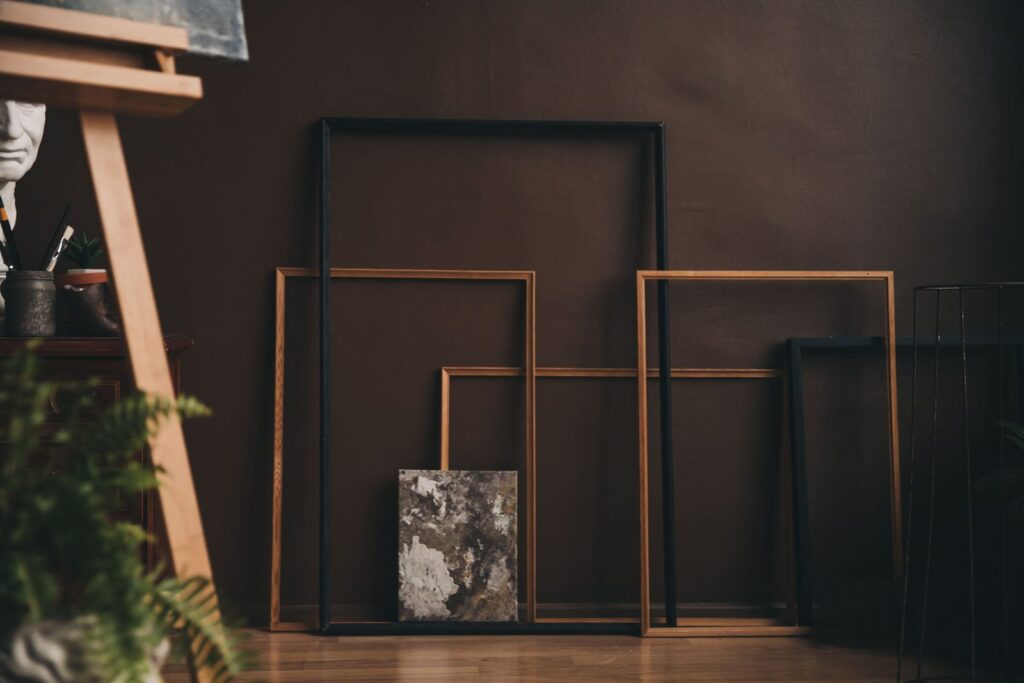
A frame has two jobs, and most framing decisions go wrong because people only think about one of them. The first job is to present the work: to set it off from the wall, give it an edge and suit the room it hangs in. The second is to protect it: from light, from dust, from handling and from the materials of the frame itself. A frame that looks superb and slowly yellows the paper inside it has failed at the job that matters more.
Knowing what each component does, and which of them drives the price, lets you spend where it counts and save where it does not.
The parts of a framed work
A framed work on paper is a small stack of layers, and each one is a decision.
- The moulding is the frame itself: wood, metal or a composite, in a profile and finish.
- The glazing is the glass or acrylic sheet on the front.
- The mat, called a mount in British usage, is the board with a window cut in it that sits between the artwork and the glazing.
- The mounting is how the artwork is attached, usually to a backing board behind the mat.
- The backing closes the package at the rear and keeps out dust and insects.
Canvases are different. A painting on a stretcher is not usually glazed or matted, and the frame is chosen mostly for presentation, though glazing and a backing board can be added for protection.
Frame styles
Traditional mouldings
Profiled wood frames, gilded or painted, remain the default for historical work and for many figurative paintings. The width and weight of the moulding should match the visual weight of the picture: a heavy gilt frame around a small, quiet drawing overwhelms it, while a thin strip around a large, dense oil can look like an afterthought.
Gallery and minimal frames
Plain wood or metal profiles in black, white or natural finishes are the contemporary standard, particularly for photographs and prints. They step back and let the work carry the room. Buying several pieces in the same simple profile is also the easiest way to make a group of different works hang together.
Floater frames
A floater, or tray frame, is used for stretched canvases. The painting sits inside the frame with a narrow gap all round, so that it appears to float, and the edges of the canvas remain visible. It suits contemporary painting and is usually cheaper than a full traditional frame because there is no glazing or mat.
Float mounting for works on paper
Works on paper can also be floated: the sheet is attached to a backing board, with its deckled or torn edges visible, and set back from the glazing with spacers. It shows the whole object rather than a window onto it, which suits handmade paper and works where the edge is part of the piece.
Glazing: the choice that matters most
Light damage is cumulative and irreversible, and glazing is the main defence a frame offers. The options fall into a few groups.
| Glazing | What it does | Best for |
|---|---|---|
| Standard picture glass | Basic protection from dust and touch; little UV filtering; reflective | Inexpensive posters and reproductions |
| UV-filtering glass | Filters most ultraviolet light; manufacturers of conservation glazing rate it at up to 99 percent | Original works on paper, photographs, anything you want to keep |
| Anti-reflective glass | Coated to cut reflections so the glass almost disappears | Works hung opposite windows or under strong light |
| Museum-grade glass | Combines UV filtering with anti-reflective coating | Valuable originals where viewing matters as much as protection |
| Acrylic | Lighter and shatter resistant, available with UV filtering and anti-reflective coatings; scratches more easily and carries static | Large works, works that travel, public spaces |
One rule to remember: do not put pastel, charcoal or soft chalk behind acrylic. The static charge on acrylic can pull loose pigment off the paper and onto the inside of the sheet. Glass is the safer choice for friable media.
UV filtering reduces damage but does not stop it. Visible light fades sensitive pigments too, so no glazing makes it safe to hang a watercolour in direct sun.
Mats and mounting: where conservation happens
A mat does more than add a border. It keeps the artwork from touching the glazing, where condensation and pressure can cause damage, including photographs and prints sticking to the glass.
The material matters. Ordinary wood pulp board contains acids that migrate into the artwork over the years, and the brown line that appears along the bevel of an old mat is the visible sign of it. For anything you value, ask for acid-free conservation board or 100 percent cotton rag board, often called museum board.
How the work is attached matters as much. Conservation framing uses methods that can be undone without harming the work, such as hinges of Japanese tissue with starch paste, or corner pockets that hold the sheet without any adhesive touching it. Pressure-sensitive tape, glue along the edges and dry mounting to a board are all difficult or impossible to reverse. Dry mounting has its place for posters and photographic display prints, but it should never be used on an original work on paper you care about.
What drives the cost
Custom framing prices vary widely between shops and cities, so the useful thing is to know which choices move the total.
- Size. Moulding is priced by length and glazing by area, so cost rises quickly as dimensions grow. Very large works also need stronger mouldings and more labour.
- Glazing. Museum-grade and anti-reflective glazing typically cost considerably more than standard glass, and on a large piece the glazing can be the biggest line on the quote.
- Moulding. Hand-finished and gilded frames cost far more than machine-made profiles.
- Mats. Rag board costs more than standard board, and double or triple mats add material and cutting time.
- Standard sizes. Ready-made frames in common sizes are much cheaper than custom work. If the artwork fits one, a ready-made frame with a custom-cut conservation mat is often the best value.
The sensible allocation is to spend on the parts that protect the work, conservation mat, reversible mounting and UV-filtering glazing, and to economise on the moulding if you must. A plain frame can be replaced later; paper yellowed by a cheap mat cannot be put back.
Questions to ask a framer
- Is the mat board acid-free or cotton rag?
- How will the work be attached, and can it be removed without damage?
- What UV protection does the glazing offer?
- Is there a spacer or mat between the work and the glazing?
- Is the back sealed against dust?
A good framer will answer all five without hesitation. If you are framing a print, it is also worth knowing exactly what you have bought before choosing the level of protection; our explainer on editions and reproductions will help you tell.